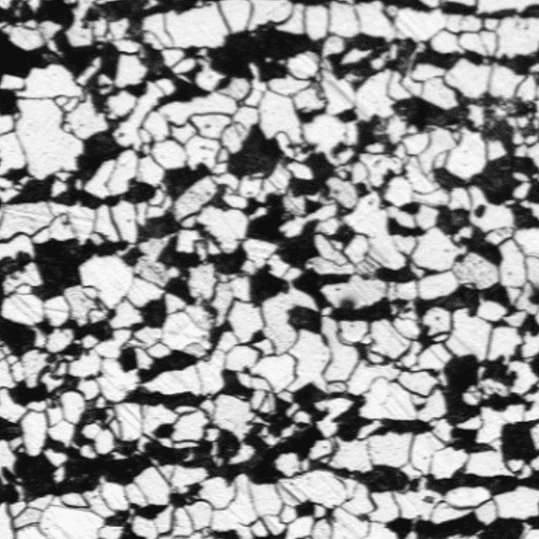
Volume Fraction (ASTM E562) Module
Volume fraction quantifies the proportion of a field of view occupied by a given phase or constituent, and is one of the most widely used quantitative metallography measurements tied to a formal test method. Clemex's volume fraction module implements the systematic manual point count procedure of ASTM E562, with the point classification step itself fully automated: the phase of interest is segmented by threshold-based image analysis rather than judged point-by-point by an operator.
Two test grid geometries, one automated detection engine. Apply a square grid for a uniform, isotropic sampling of the field, or a radial grid when the microstructure of interest varies with distance from a reference point, and let automated threshold detection classify every test point.
See analysis report
See It In Action
Volume Fraction (ASTM E562) Module in Motion
Analysis Workflow
A General Volume Fraction Workflow
Regardless of which test grid is selected, volume fraction measurement in Clemex Vision follows the same underlying workflow, and only the geometry of the test grid changes.
Capture/load the image
An image of the polished sample is captured live through the microscope, or a previously saved image is loaded, at a known magnification and calibration factor.
Automated threshold detection
The phase of interest is automatically segmented from the matrix using threshold-based image analysis, with no manual tracing or binarization required.
Apply the test grid & measure
A square or radial grid of test points is superimposed on the field; every point falling on the detected phase is classified, counted, and converted into a volume fraction automatically.
Generate report
Field area, calibration, and the estimated volume fraction Vv (%) update instantly in the results panel and feed a report compliant with ASTM E562.
Analysis Modes
Two Ways to Measure Volume Fraction
Clemex Vision supports two test grid geometries within the same volume fraction module, both driven by the same automated threshold detection, so the sampling pattern can be matched to how the microstructure is distributed across the field.
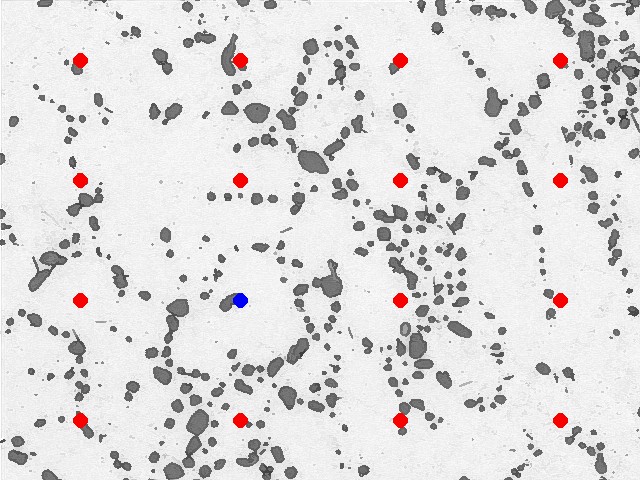
Square (Regular) Test Grid
A regularly spaced grid of test points, evenly distributed in rows and columns, is superimposed on the automatically thresholded image. Every point landing on the detected phase is counted and combined with the total number of test points to estimate the volume fraction. Well suited to microstructures that are homogeneous and isotropically distributed across the field.
Best for isotropic structures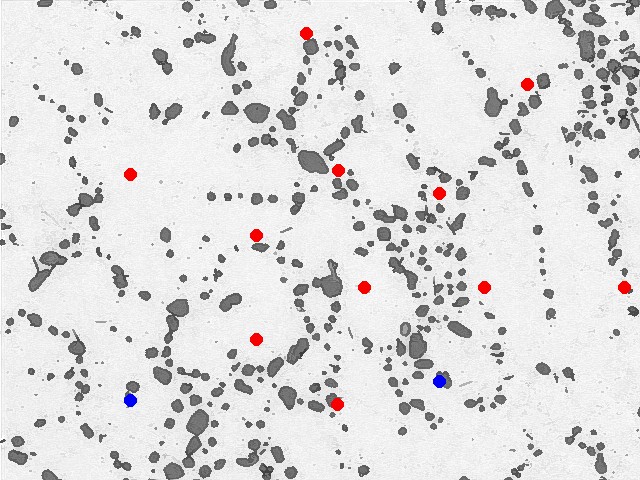
Radial (Non-Uniform) Test Grid
Test points are distributed with a non-uniform, radial layout rather than a fixed row-and-column spacing. The same automated threshold detection classifies each point, making this pattern useful when the phase distribution of interest varies with position or direction across the field rather than being uniformly spread.
Best for non-uniform samplingChoosing the Test Grid
Square Grid vs. Radial Grid
Both test grids rely on the same automated threshold detection step to classify the phase of interest; what changes is how the test points are laid out over the detected phase, and therefore how evenly the field is sampled.
| 1 · Square Grid | 2 · Radial Grid | |
|---|---|---|
| Best suited for | Homogeneous microstructures, evenly distributed across the field | Microstructures whose distribution is not uniform across the field |
| Point layout | Fixed spacing in rows and columns (e.g. a 4×4, 16-point grid) | Non-uniform placement, sampling the field without a fixed row/column spacing |
| Phase detection | Automated threshold segmentation | Automated threshold segmentation (identical detection engine) |
| Point classification | Automatic, no manual point-by-point judgment | Automatic, no manual point-by-point judgment |
| Reported result | Volume fraction Vv (%) per field, per ASTM E562 | Volume fraction Vv (%) per field, per ASTM E562 |
What Gets Measured
Metrics Computed by the Volume Fraction Module
Whichever test grid is used, the module reports the figures required by ASTM E562 alongside the calibration data needed to reproduce the measurement.
Point Count Result
Volume Fraction
Volume fraction Vv (%)
The estimated fraction of the field occupied by the phase of interest, points landing on the detected phase divided by the total number of test points, expressed as a percentage.
Points of test grid
The total number of test points applied to the field, 16 points in a typical square grid pass, as shown in the reference report.
Field & total area (µm²)
The real-world area of the analyzed field of view, and the cumulative area across all fields analyzed for the sample.
Calibration & Traceability
Setup & Confidence
Calibration (µm/pixel)
The pixel-to-micron conversion factor tied to the magnification used, ensuring reported areas and results scale correctly.
Field count & magnification
The number of fields analyzed and averaged into the overall result, together with the magnification used to capture them.
Statistical confidence
As more fields are analyzed, the reported volume fraction becomes more statistically representative of the sample as a whole.
Analyzing multiple fields per sample, rather than a single field, produces a more statistically representative result, regardless of whether a square or radial test grid is used.
Frequently Asked Questions
What is volume fraction and why does ASTM E562 matter?
Volume fraction is the proportion of a microstructure occupied by a given phase or constituent. ASTM E562 defines a systematic manual point count procedure for estimating it, giving labs a standardized, reproducible reference method to report against.
How does automated threshold detection differ from the manual point count in ASTM E562?
The standard's manual procedure has an operator judge, point by point, whether each grid intersection falls on the phase of interest. Clemex's automated mode replaces that judgment step with threshold-based image segmentation, so every point is classified consistently from the same detected phase.
When should I use a square grid instead of a radial grid?
A square grid samples the field uniformly and is the natural choice for microstructures that are homogeneous and isotropically distributed. A radial grid spaces its test points non-uniformly and is more appropriate when the phase of interest is not evenly spread across the field.
Does changing the test grid change how the phase is detected?
No. Both grid modes use the same automated threshold detection to identify the phase of interest; only the placement of the test points used to sample that detected phase changes between the square and radial modes.
What does the analysis report include?
Each report records the calibration factor, magnification, field and total area analyzed, the number of test grid points, the field count, and the resulting volume fraction Vv (%), consistent with ASTM E562 reporting requirements.
How many fields should be analyzed per sample?
Analyzing multiple fields produces a more statistically representative result. A single-field pass, like the reference report shown here, is a useful starting point, but additional fields tighten the estimate.
Ready to Measure Volume Fraction?
Talk to a Clemex expert about the automated square and radial grid routines, or request a live demo on your own sample images.