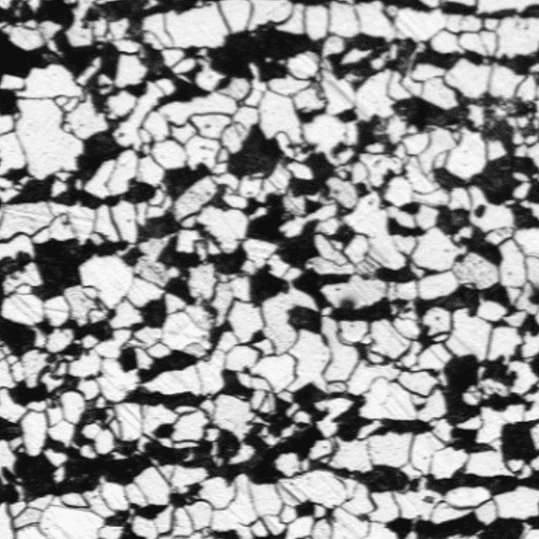
Inclusion Rating in Steel as per ASTM E45, Methods A & D
This module provides a complete set of image analysis routines for detecting, classifying, and rating non-metallic inclusions, including sulfides, aluminas, silicates, and globular oxides, in polished steel sections. Threshold-based instructions running inside Clemex Vision discriminate inclusion from matrix and from each other by gray level and shape, reconnect inclusions that span several fields, and generate a standardized single-page report compliant with ASTM E45 Methods A and D.
One scan, every rating method. On Clemex Vision, the same field-by-field data is reported to ASTM E45 Method A (worst field) or Method D (full severity distribution). With Clemex CIR, the software dedicated to inclusion analysis, the same scan is also compliant with JIS G0555 and DIN 50602 / EN 10247, generated automatically from the same analysis pass.
Check analysis reports
See It In Action
Inclusion Rating in Steel as per ASTM E45, Methods A & D
Analysis Workflow
From Polished Section to Standardized Report
Calibrate & set threshold
Magnification is calibrated, and the gray-level threshold separating matrix, sulfide, and oxide is set and verified.
Define pattern & scan
A field pattern is set, then the motorized stage scans it, classifying each inclusion by gray level and shape.
Reconnect & validate
Inclusions spanning several fields are rebuilt, worst fields are flagged for review, and artifacts are cleared with a click.
Rate & report
Ratings are generated under Method A or Method D, and the report is generated automatically.
Module Capabilities
What the Module Does
Beyond the core Method A and Method D routines, the module includes a range of capabilities designed for production metallography labs.
Inclusion Classification
Automatically classifies inclusions into sulfide, alumina, silicate, and globular categories by gray level and shape, with each category split into thin and heavy series.
Automated Field Reconnection
When an inclusion covers more than one field, the module rebuilds it from its parts so the entire length is considered in the rating, not just the visible fragment.
Multi-Standard Reporting
The same analysis is reportable under ASTM E45 (Methods A, C, D, E), JIS G0555, and DIN M / DIN K, with the appropriate scale and terminology applied automatically.
Report & Data Export
Reports print directly from Clemex Vision with sample information, category ratings, and the oversize listing. Results can also be exported for further processing.
Rating Methods Coverage
Method A vs. Method D
Both methods classify the same four inclusion categories from the same scan. They differ in how the field population is condensed into a rating.
| Method A | Method D | |
|---|---|---|
| Rating basis | Worst field per category, compared against standard charts | Every analyzed field scored on the same severity scale |
| Output | One thin and one heavy value per category | Count of fields at each severity level, per category |
| Severity scale | Chart-matched thin / heavy series | 0.5 to 5.0, in 0.5 increments |
| Categories covered | Sulfide A, Alumina B, Silicate C, Globular D | Sulfide A, Alumina B, Silicate C, Globular D |
| Best used for | Quick conformance against a specification limit | Characterizing overall cleanliness across the sample |
| Cross-referenced to | JIS G0555 equivalent rating | DIN equivalent rating |
Rating Configurations
Three Ways to Report the Same Scan
Each configuration uses threshold-based instructions to detect and classify inclusions automatically. Ratings are generated in real time and can be recalculated to a different method without rescanning the sample.
Worst-Field Rating
Automates the traditional chart-comparison approach: each category's worst field is matched to the ASTM standard charts and reported as a single thin and heavy value.
ASTM E45 · JIS G0555Severity Distribution
Scores every analyzed field on the 0.5 to 5 severity scale and tallies the field count at each level per category, giving a full picture of sample cleanliness.
ASTM E45 · DIN K / DIN MMethod A + D, Multi-Standard
Runs Methods A and D from the same scan and adds JIS G0555 and DIN equivalents to a single report, along with the full oversize inclusion listing.
ASTM E45 · JIS · DINWhat Gets Measured
Metrics Computed by the Module
Each analysis builds a comprehensive statistical picture of the inclusion population across the scanned field pattern.
Inclusion Statistics
Rating & Classification
Category rating (thin / heavy)
Method A worst-field rating for each of sulfide, alumina, silicate, and globular categories, split into thin and heavy series.
Severity distribution
Method D count of fields at each severity level (0.5 to 5.0) for every category and series.
Reconnected length & width
Length, width, and equivalent circle diameter of oversize inclusions after multi-field reconnection.
Sample & Standards
Field & Report Data
Field & sample geometry
Sample width, height, total area analyzed, calibration factor, and magnification, logged for every heat and sample.
Oversize count & listing
Every inclusion beyond the standard's size cutoff, listed individually with category, length, and width.
Multi-standard totals
JIS G0555 percentage values and DIN K / DIN M index totals, computed from the same underlying inclusion data.
Frequently Asked Questions
What is the difference between Method A and Method D?
Method A rates only the worst field found for each inclusion category, matched against the ASTM standard charts. Method D instead scores every analyzed field on the same 0.5 to 5 severity scale and reports how many fields fall at each level, giving a full distribution rather than a single worst-case value. Both are computed from the same scan.
What are the four inclusion categories?
Sulfide (Type A) and silicate (Type C) are elongated inclusions that string out along the working direction. Alumina (Type B) is a brittle oxide that breaks into aligned chains of angular fragments. Globular (Type D) inclusions are roughly round oxide particles that keep their shape regardless of working direction. Each category is further split into thin and heavy series.
How does the system tell a sulfide from an oxide?
A gray-level threshold is set and verified before the scan: everything below a cutoff is treated as one class of inclusion, everything above as the other. Shape analysis then separates the individual categories, for example distinguishing elongated alumina chains from globular oxides.
What happens when an inclusion spans multiple fields?
The module detects the partial inclusion in each field it touches and reconnects the pieces into a single object once the scan is complete, so its full length and width, not just the fragment visible in one field, are what enters the rating.
Can results be reported under JIS or DIN alongside ASTM?
Yes. The same underlying inclusion data can be expressed as ASTM E45 (Methods A, C, D, or E), JIS G0555, or DIN M / DIN K in the same report, without re-running the analysis.
How are dust and polishing scratches handled?
Artifacts from sample preparation can be picked up as false detections. The operator reviews the flagged worst fields and removes any dust or scratch with a single click before the final rating is generated.
Ready to Rate Inclusions in Your Steel Samples?
Talk to a Clemex expert about Method A, Method D, and multi-standard reporting, or request a live demo on your own sample images.